Glencoe Hendersons

Norsemen settled the lands around Glencoe and Ardnamurchan. When George M. Henderson, a Canadian, visited the area in the 1960s, the local lore was that the Glencoe Hendersons had Norse ancestry, because the inhabitants, like the Northmen, were noted for their size and strength, as well as their general appearance, including fair skin and hair.
The Chieftain of the MacEanruigs ruled Glencoe for some three centuries until displaced by the MacDonalds, when King Robert the Bruce gave the area to Angus Og, Lord of the Isles, and Chief of Clan Donald, for his support at Bannockburn in 1314. The last Henderson Chief at Glencoe was Dugald MacHendry.
In 1292, the chiefship descended with the duthus (principal estate), not with the person. As tradition held at the time, Dugald MacHendry’s daughter married into Clan Donald and the chiefship passed on with her. Her husband was Iain Fraoch (Heather John), on whom Angus bestowed the lordship of Glencoe.
Fraoch and his wife lived at Inverlochy for a time and it was there that their first son and heir was born. He was known as Iain Abrach, or John of Lochaber. In due time, he became the first MacIain of Glencoe. According to the old Scottish law of succession, the Henderson chiefship passed down to him from his mother.
The MacDonalds and the MacEanruigs lived amicably together. Although our ancestry lost their lands and their status as a separate clan, there were Hendersons still living in this Highland glen long after MacIain’s power was gone. Generally speaking, the Hendersons lived in two townships in the rugged valley of Glencoe — Carnoch and Achnacone — and it was in these townships that MacIain kept his summer and winter homes.
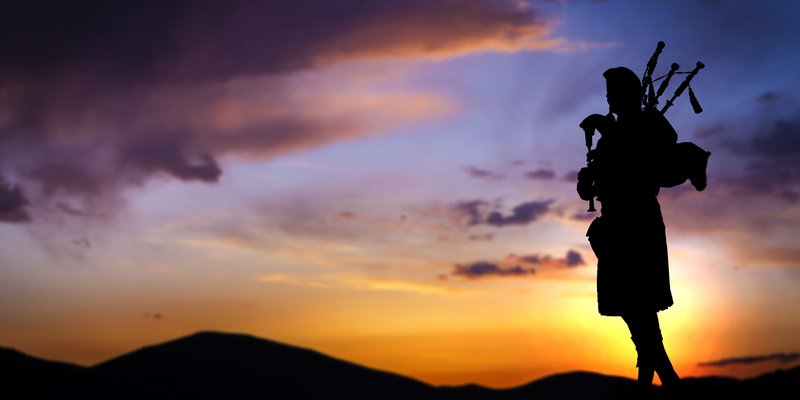
Old Iain Fraoch appointed the Hendersons to be his hereditary pipers. One of our ancestors, Big Henderson of the Chanters, was remembered as MacIain’s personal hereditary piper, but little else is known about him. Also designated as his bodyguard, the Hendersons performed a vital function and, until the death of the last MacIain Chief, they were accorded the honour of the first “lift” of the remains when the chiefs were carried to the burial plot.
The 1692 Massacre at Glencoe — Murder Under TrustOne of the bleakest pages of Clan Henderson’s history began shortly after the defeat of the Jacobites at Killecrankie in 1689. Uneasy with the still-rebellious nature of the Highlanders, King William of Orange offered indemnity to all those Highland rebels in exchange for signing an oath of allegiance by a deadline of 1 January 1692. Many chiefs were late in signing.
Several explanations have been offered why MacIan took the oath late. Some claim he misread the proclamation, others that he was delayed by a snowstorm. Nonetheless, he signed the oath on 9 January, assured by Campbell of Arkinglas that MacIain had the protection of the garrison at Fort William.
Sir John Dalrymple, the Under-Secretary of State, was determined to make an extreme example of the MacIains. On 11 January, Dalrymple issued instructions for an attack: “This is the proper season to maul them in the cold, long nights.” He added: “I hope the soldiers will not trouble the Government with prisoners.”
On 1 February, two companies of government troops — about 120 soldiers commanded by Captain Robert Campbell — set out from Fort William to Glencoe. The MacDonalds received Campbell and his soldiers warmly, even though there had been a long-standing Highland rivalry between the Campbells and the MacDonalds. Captain Campbell’s niece was married to the MacDonald chief’s younger son.
For ten days, the residents of Glencoe — Hendersons, MacIains, Johnstons, MacColls, Rankins, and other families — generously extended the hospitality of their homes. A historian of the time wrote: “They had all been received as friends by these poor people, who intending no evil themselves, little suspected that their guests were designed to be their murderers.”
On 12 February 1692, additional troops presented Captain Campbell with orders from Fort William: Kill all MacDonalds under the age of 70.
The Henderson StoneOne story, never fully substantiated, recounts that one of Campbell’s soldiers asked one of his Henderson hosts to accompany him on a walk after the evening meal on the night before the massacre. During the walk, the soldier and his Henderson host came upon a large stone. Pausing before it, the soldier said: “Ach, grey stone, ye havin’ been every right ta be where you are, but if you were ta be knawin’ what I be knawin’, ye twad nae be here in the morn.” Today, this stone is known as Clach MacEanruig (Henderson Stone).
As instructed, Campbell and his troops began their bloody work promptly at 5 the next morning. Old MacIain, 70, was killed in his nightshirt, shot through the back of the head. His wife was beaten and one of her fingers bitten off to steal her gold rings. The soldiers set fire to the home and dragged her out to die in the snow. In all, some thirty-eight residents of the Glen, including children and infants, were murdered. The dead included 22 Hendersons.
But it could have been worse. The soldiers had failed to seal off the pass out of the glen, allowing about 150 men and their families to escape. After the hint from the Campbell soldier, some of the Hendersons reportedly stayed awake and on guard through the night.
The Hendersons were bodyguards and pipers to the MacDonalds. The MacDonalds traditionally used a large rock escarpment nearby as a place to signal other clan members — “Signal Rock.” However, the Henderson pipers would always choose Clach MacEanruig (Henderson Stone) as their platform for any rallying call. On the morning of the massacre, the English Regimental Piper used the less-effective Signal Rock. This may account for why some troops never sealed the glen.
Scots and English alike greeted the news with shock and outrage. Because of the high levels from which the treachery had originated, the act was deemed to be “murder under trust.” But Dalrymple, the primary instigator, was protected by his king and managed to escape prosecution.
The Glencoe Connection to Black Cape (Quebec, Canada)Public records indicate that a Richard Henderson of Kirconnel, in Dumfries, married Jean Brown in Lanark in 1799. A son, James Henderson, was born 25 June 1804, in Ayrshire. At about the age of 24, James emigrated to Canada and became a member of a substantial colony of Scots in Black Cape, Quebec. The Hendersons in Black Cape appear to trace their ancestry to Glencoe, since records show their physical features tend to track those of the Glencoe Hendersons — tall (six feet or more), blonde, blue-eyed, long-armed and noted for their athletic prowess.
Last updated: March 21, 2026